The Moon’s Brightest Promise:
Helium-3 and the Commercial Push to Mine Space
· By Heaven Sullivan ·
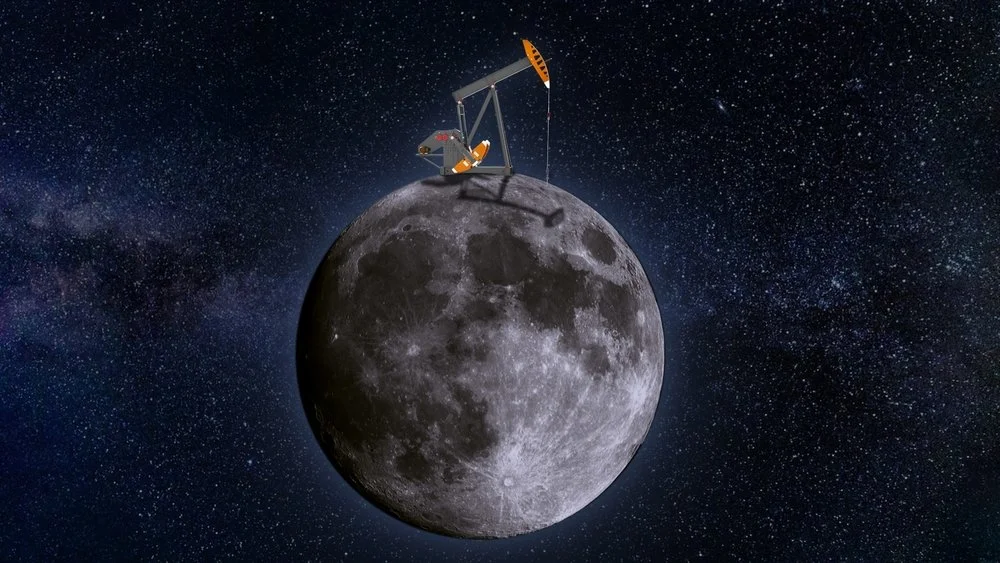
The United States and China are in fierce competition to establish a permanent presence on the Moon, in part to extract resources from it. One of the most promising of these resources is Helium-3, a rare isotope abundant on the lunar surface. Its potential applications in fusion energy and quantum sciences has intensified international competition for lunar access. Public opinion polls show this pursuit to be popular among Americans, with 69% of them agreeing that the U.S. must be a leader in space and 75% believing that the search for resources and materials beyond Earth should be a top NASA priority or an important mission. Yet, it is the commercial sector, not NASA, leading efforts to acquire Helium-3.
When used as a fuel for nuclear fusion, Helium-3 is safer and less environmentally costly than current energy sources. As an alternative to traditional fission-based nuclear energy, it produces no long-lived radioactive waste and avoids the risk of catastrophic meltdowns or explosions. Helium-3 fusion is also a zero-carbon competitor to fossil fuels such as coal and gas. According to the chief scientist of the Chinese Lunar Exploration Program, “the Moon is so rich in Helium-3 that it could solve humanity’s energy demand for at least 10,000 years.” Though a contested figure, there is plausible evidence that fusion energy could alleviate many global energy and climate crises. NASA scientists have understood the potential application of lunar Helium-3 for fusion power since the Apollo program, but the absence of lunar missions after Apollo and historical stagnation in fusion energy engineering left these visions largely theoretical–until now.
Another application of Helium-3 is as a coolant for quantum computing. Compared to their classical counterparts, quantum computers are able to simulate and solve problems that are too difficult for current models, including new discoveries in fields such as material science and biomedical research. Significant risks exist as well. Quantum computing could threaten secure communications by enabling decryption that would take traditional computer thousands of years to accomplish. To get there though, quantum computers need more sophisticated cooling mechanisms. Helium-3 can be used to used cool quantum devices to near zero temperatures, the ideal condition needed for future advancements. Together, these technological promises have transformed lunar extraction from a speculative idea to a commercial endeavor.
LH3M is an Arizona-based lunar mining startup focused exclusively on extracting Helium-3 from the Moon’s surface. CEO Chris Salvino nevertheless acknowledges three fundamental barriers to the isotope’s ability to drive so many breakthroughs. First, lunar mining technology needs more development. The process must withstand a harsh environment with one-sixth of the Earth’s gravity and extremely high levels of dust that interfere with robotics. LH3M is addressing both problems and was recently awarded several patents for spacecraft design that may provide solutions. Second, transportation costs to and from the Moon are too high, though reusable launch vehicles from SpaceX and Blue Origin offer the prospect of cheaper alternatives. Third, commercialization of nuclear fusion remains unprofitable, though advances are also being made in this area. Startups such as Helion Energy and NearStar Fusion are developing ways to use Earth-based resources to lower the cost of generating energy from fusion. Salvino believes that lunar Helium-3 will be key to achieving this.
Experts largely agree that lunar resource extraction is essential for a sustained presence in space, but the economic viability of bringing the resources to Earth is contested. Some believe that the price of extracting and transporting resources in space will always be greater than their value. This may explain why the majority of recent space-based economic activity is related to satellites that support our information-driven world. Between 2015 and 2024, 35% of private investment in space startups was for communication, remote sensing, and PNT (positioning, navigation, and timing) satellites. Another 33% was solely to support launch capability. Mining the Moon and asteroids is a low priority for investors seeking short-term returns. That is unlikely to change until launch costs fall dramatically. If they do, Helium-3 extraction may prove to be the Moon’s most lucrative resource given its potential use in frontier technologies such as fusion energy and quantum.
Legal questions also complicate space mining. The Outer Space Treaty is the principle international agreement governing state activity in the cosmos, and it prevents appropriation of celestial bodies but fails to address resource extraction. The UN attempted to address the gap in the Moon Agreement, which came into force in 1984. It declares that all celestial bodies belong to mankind and natural resources should not be owned by any one entity. The U.S., China and Russia, however, are not signatories. In fact, many countries, ranging from the U.S. and Luxembourg to the United Arab Emirates and Japan, have adopted national-level legislation legalizing the mining of celestial bodies. China, for its part, submitted in 2024 a document to the UN Committee on the Peaceful Uses of Outer Space that signaled agreement with other major space-faring nations on the matter: Beijing believes that resource extraction is legal as long as it complies with the Outer Space Treaty.
The first nation to establish a permanent presence on the Moon will undoubtedly be instrumental in forging legal clarity, a decisive advantage in harnessing the power of lunar resources including Helium-3. As the U.S. and China compete for that distinction, the commercial sector is making progress on its own lunar ambitions. In October, LH3M created a “Moon-to-Europe” resource supply chain that will supply Mosae Zorg Industries, a Berlin-based quantum computing company, with Helium-3. The agreement’s existence in the face of major technological, economic, and legal hurdles speaks to the isotope’s potential for the future of humanity’s most vital industries. But other challenges also persist. As nations and companies continue looking to space to solve problems on Earth, stronger diplomacy and international cooperation will be necessary to ensure that geopolitical tensions do not break the promises of celestial exploration.