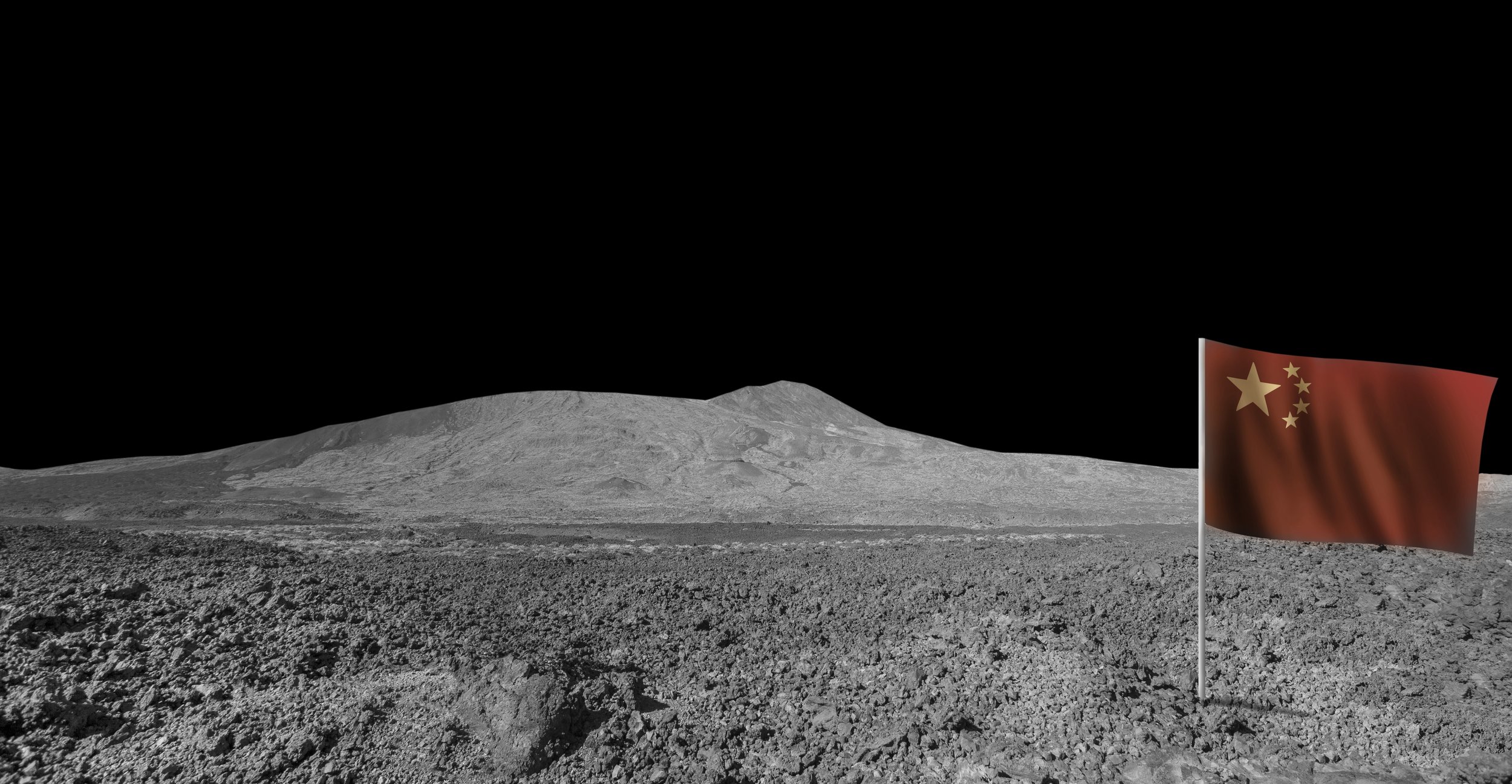
The Moon is Just a Means; China’s Real Prize is Helium-3
· By Howard Chang ·
Much of the conversation about Sino-American space ambitions is drifting back to the Moon. U.S. Senator Ted Cruz (R-Texas) acknowledged this by convening a September 2025 Commerce committee hearing entitled “There’s a Bad Moon on the Rise: Why Congress and NASA Must Thwart China in the Space Race.” It showcased former NASA Administrator Jim Bridenstine, who testified that “it is highly unlikely the United States will beat China’s projected timeline” of reaching the Moon by 2030. Days later, Interim NASA Administrator Sean Duffy stated that the United States would do it and win “the second space race.” He forcefully doubled down by claiming that “this time, when we plant our flag, we stay.”
None of the conversations, however, noted why China is anxious to get the Moon. U.S. leaders speak as if it were the space race of old, a symbolic show of power and technical capability. But China has had, for more than a decade, a different reason for reaching Earth’s satellite. The country wants to mine for helium-3.
But what is helium-3, and why is it so coveted? In short, it is an isotope that may permit cold fusion, a type of nuclear reaction that occurs around room temperature. Typical nuclear fusion requires extreme heat or pressure. But if proven viable, cold fusion would provide clean, abundant energy with minimal environmental impact. And even if helium-3 does not allow cold fusion, it is a non-radioactive isotope that could be key to a process that produces significantly less nuclear waste than traditional nuclear fusion. Simply put: helium-3 could solve many of the world’s energy problems.
There is, however, a catch. The world is running out of helium-3, and most of it is likely trapped in Earth’s mantle or core. In fact, the isotope is so rare that its cost is estimated at $20 million per kilogram. But on the Moon, helium-3 can be found at the south pole because there is no atmosphere or magnetosphere to deflect solar wind depositing helium-3 isotopes in lunar regolith. Some parts of the lunar regolith are also rich in ilmenite, a mineral that expertly traps helium-3 particles.
Ouyang Ziyuan, chief of the Chinese Lunar Exploration Program better known as the Chang’e Project, is a geologist and chemist. He has long been open about his interest in helium-3 and its capabilities, noting in 2013 that it could “solve human beings’ energy demand for around 10,000 years at least.” In 2019, Zhang Kejian, then the director of the China National Space Administration (CNSA), announced that his country planned to build a research station on the Moon’s south pole “in the next 10 years.”
Access to helium-3 could be significant for China because a significant portion of its energy is now produced by coal-fired power plants. This reliance on coal casts China as an energy-poor and energy-inefficient nation. But it could become an energy superpower if it emerges first in the race to extract, process, and use helium-3. Controlling a large enough industrial base at the lunar south pole would give Beijing an advantage over any other country’s initial plans to extract resources there. And the U.S.-led Artemis Accords’ proposed “safety zones” would expand the area a country effectively maintains beyond its physical infrastructure, allowing countries the opportunity to strategically control lunar resources past walls and fence lines.
U.S. stakeholders recognize the power of helium-3. NASA scientists studying the Apollo-era lunar samples confirmed that the isotope is present in lunar regolith, and a 2021 NASA paper even proposed helium-3 mining concepts for the Moon. The agency also issued a 2025 request for information on a lunar (and a Martian) fission surface power system. Harrison Schmitt, an Apollo 17 astronaut who walked on the Moon, and the only geologist to do so, has estimated that a single space shuttle payload of helium-3 could power the United States for a year. He also said in 2013 that “China has made no secret of their interest in lunar helium-3 fusion resources. . . . In fact, I would assume [the Chinese Yutu lunar rover] mission is both a geopolitical statement and a test of some hardware and software related to mining and processing of the lunar regolith.” The CNSA has never confirmed a lunar mining operation.
The United States gains no ground returning to the Moon without a sustained presence at its south pole. But if it wants to win this new race, one that recognizes China’s energy ambitions, then Washington must consider the necessary funding and measures to launch a helium-3 mining operation on the lunar south pole by 2030. The needed resources would likely be far above NASA’s allowance in the president’s proposed fiscal year 2026 budget, which actually reduces the agency’s funding by 25%. The foundation for the U.S. to beat China in the helium-3 race exists, forged by Apollo astronauts and NASA scientists. But the agency cannot win under a policy of austerity. It needs additional resources, whether through Congress, other government agencies (such as the Department of Energy’s Isotope Program), or commercial space contracts.
The United States must remember that the Moon is worth revisiting, whether to inspire humanity or as an opportunity to solve global energy challenges. Anything less than a sustained U.S. presence on the lunar south pole is a concession to China—and to history.
DISCLAIMER: Any views expressed are the author's own and do not necessarily reflect the views of the United States Government, the United States Attorney's Office for the District of Columbia, or the National Aeronautics and Space Administration.