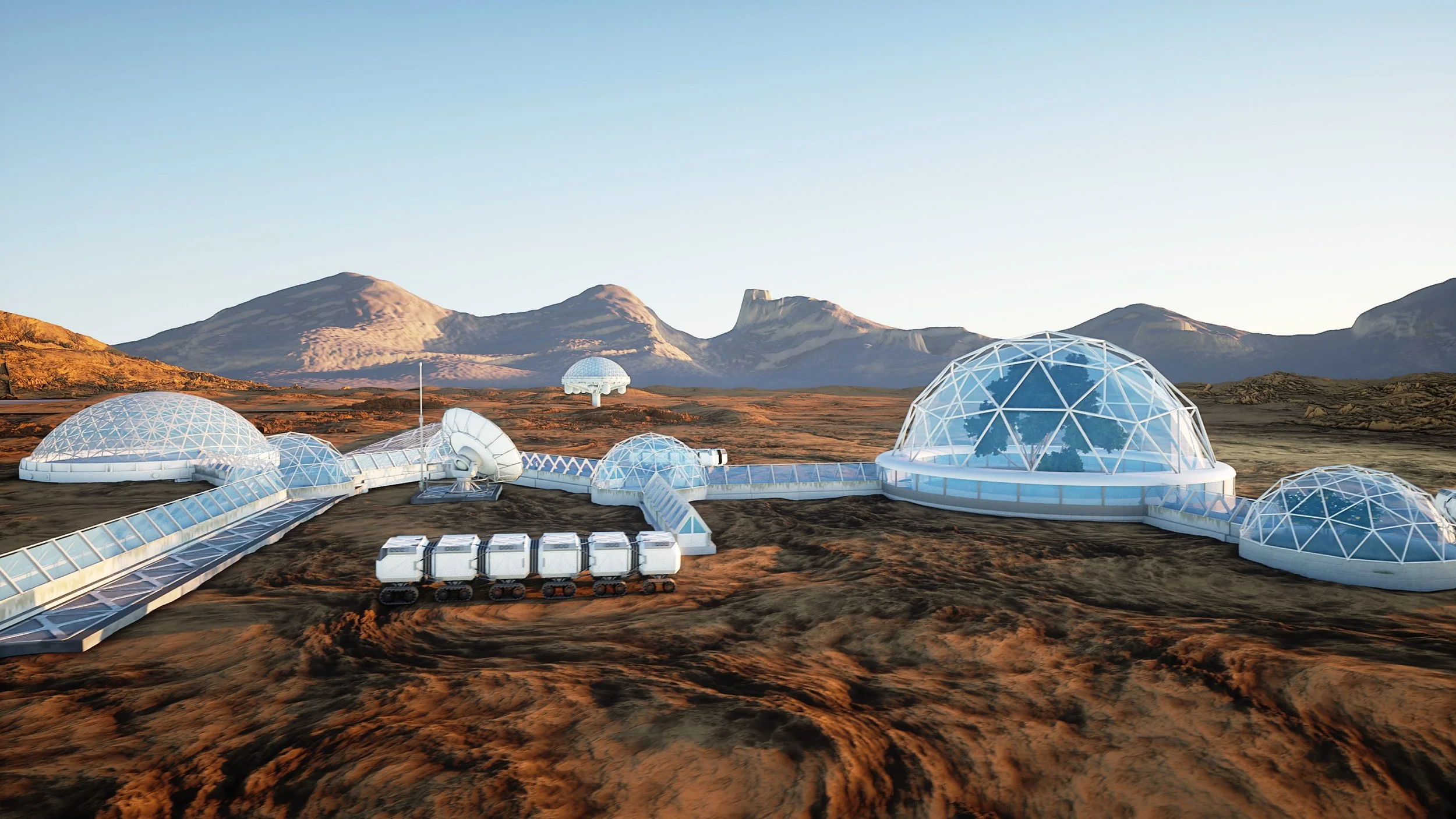
Life on Mars: Dream or Political Failure?
The neighboring planet fascinates with its potential but reveals our earthly disillusions.
· By François Buffenoir ·
Throughout history, human migrations have always followed a simple logic. People have left untenable conditions to improve their lives elsewhere. Leaving Earth to live on Mars would therefore, for most individuals, require better living conditions there.
Yet the red planet is hostile. It offers an unbreathable atmosphere, deadly radiation, and freezing temperatures. Even a polluted Earth warmed by 4°C would remain far more hospitable than Mars. And were it ever possible to transform the Martian atmosphere to make it breathable, it would be infinitely simpler and more logical to do it here on Earth.
So, is settling on Mars really an answer to an uninhabitable Earth, or rather an ideological escape?
The “Martian dream” is not politically neutral. Empty of any civilization, Mars appears as a blank page, attracting those who want to free themselves from earthly order. Elon Musk speaks of it as a “life insurance for humanity”, a self-sustaining city able to survive even without supplies from Earth. Robert Zubrin, founder of the Mars Society, insists that “Mars will be ruled by Martians.” For him, the planet is not an escape but the opening of a new frontier, where different models of civilization could emerge.
The parallel with science fiction is striking. Isaac Asimov’s “Foundation” delves into a plan to safeguard humanity on Terminus, or “planet B”, but the real ambition is building a foundation for a future empire. The offer of “survival” is just a pretext to make the project acceptable. It is hard not to see similar inspiration in Musk’s Martian project.
Such a political project would nevertheless be a terrible admission of despair. Is all hope on Earth lost if we must go to a more hostile planet to create a harmonious society? Is the dream of Martian colonization appealing because, at least in part, we live in an era scarred by conflicts, inequalities, and climate and political crises that spares no continent? Could the Martian dream be the symptom of a growing sense of helplessness to reform terrestrial civilization?
Science fiction has not always portrayed space as an escape. “Star Trek” imagined a multi-planetary society, albeit one that followed a World War III that spurred humans to unite. They, with Vulcans, Andorians and Tellarites, formed the United Federation of Planets, a voluntary alliance built on exploration, cooperation, peace and mutual progress. Space became an extension of a humanity reconciled with itself, not an escape from itself.
In fiction or in reality, space exploration has never been more magnificent than when it brought us back to ourselves. William Anders’ iconic Earthrise photo, taken on December 24, 1968, during the Apollo 8 mission, stirred such emotion due to its rendering of our planet, not the moon.
That is the spirit to be retained as the study of Mars progresses. We will betray the most beautiful aspect of space exploration if we turn Martian conquest into a political project that corrodes civilization on Earth. We must not abandon our planet; we must learn to love it more.