Orbiting the Divide: How Structural Interdependence Saved the ISS from Geopolitical Collapse
· By Montserrat Zeron ·
The National Aeronautics and Space Administration (NASA) celebrated a historic milestone on November 2, 2025: twenty-five years of continuous human presence aboard the International Space Station (ISS). For a quarter century, nearly 300 people from 26 countries have lived and worked on the ISS, advancing scientific research, and fostering diplomatic relations across the world. To Cold War architects, the image of American and Russian astronauts celebrating this milestone in orbit would have seemed unthinkable.
Think back to 2000. The last time no humans lived in space, Bill Clinton was at the end of his two terms in the White House, Coldplay released their debut album, and Vladimir Putin had first come to power. Today, the seven astronauts aboard the ISS represent the United States (NASA), France (European Space Agency), and Russia (Roscosmos). In an era of deepening geopolitical fracture, outer space stands as one of the few places where adversarial nations continue to operate side by side–a noteworthy exception that has endured even in the wake of Russia’s full-scale invasion of Ukraine.
This resilience reveals a fundamental truth about space diplomacy. For 25 years, the ISS has served as a diplomatic tool that sustains cooperation despite geopolitical tensions. Space has shown itself to be an arena beyond national borders that requires mutual dependence—where scientific collaboration can persist even as other diplomatic avenues collapse.
1. The Genesis of Interdependence
This partnership emerged from Cold War rivalry. The 1975 Apollo-Soyuz mission in which American and Soviet spacecraft docked in orbit and astronauts shook hands 140 miles above Earth—proved cooperation was possible. Years later, the collapse of the Soviet Union created a new opportunity. Collaborating with the Russians in the space station program would enable them to channel their advanced technologies into a joint project under international oversight rather than allowing the proliferation of rival nuclear and missile technology. A strategic calculation by the U.S. and its partners, this political choice was engineered into the station’s architecture, making a diplomatic divorce a mutual catastrophe.
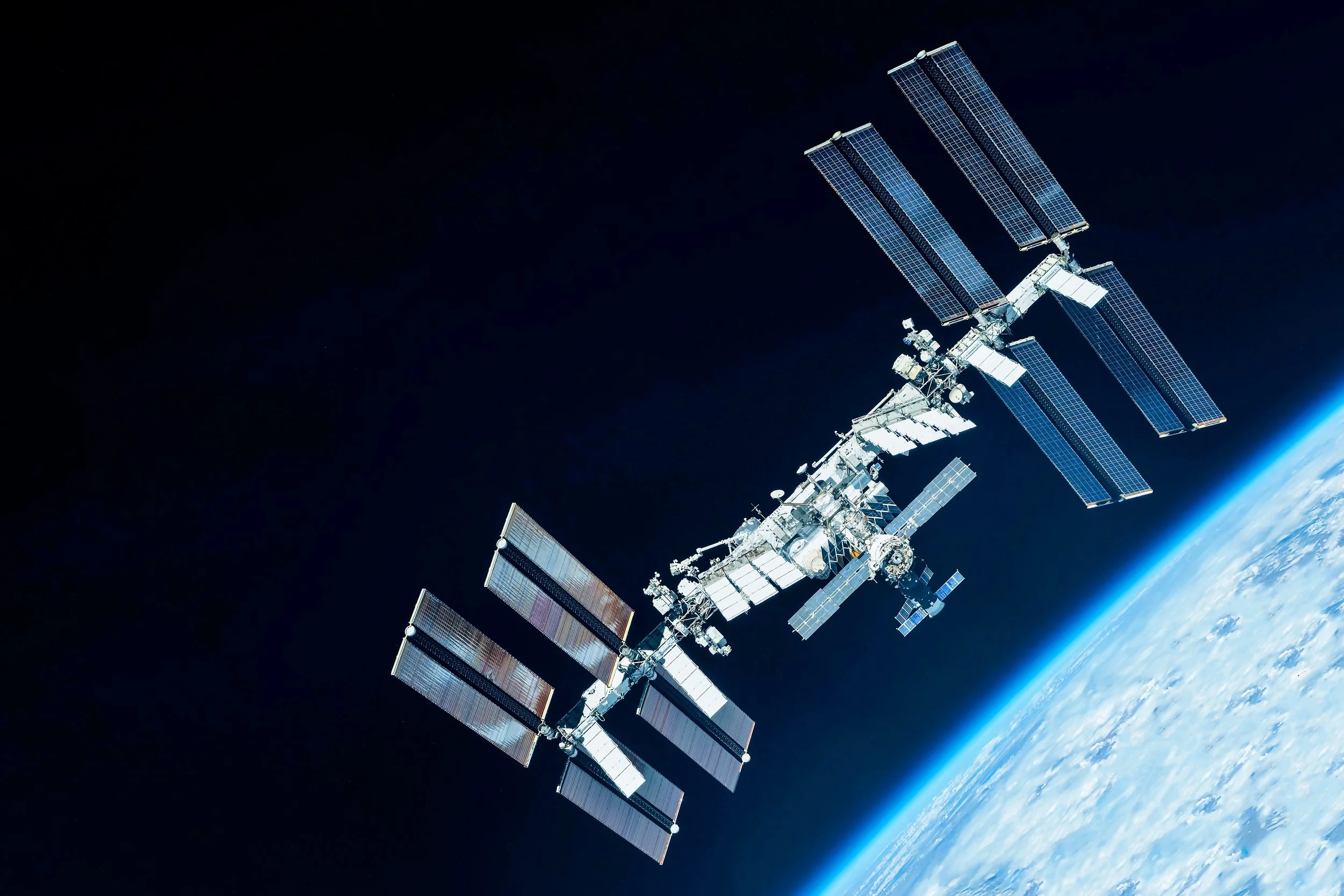
The 1998 Intergovernmental Agreement formalized this interdependence into the station’s design: the Russian Segment provides propulsion for orbital altitude, attitude control, and debris avoidance while the U.S. Orbital Segment provides gyroscopes that maintain orientation and powers the station through solar arrays. The U.S. and Russia didn’t just decide to hold hands; they built a system that physically requires both of them to survive. The station cannot be disassembled and neither side can operate without the other.
This architecture of necessity was reinforced by human bonds. American astronauts and Russian cosmonauts trained together in Star City and Johnson Space Center, learning each other’s languages, procedures, and cultures to operate the station. Then the 2003 Columbia disaster grounded NASA’s shuttle fleet, forcing the U.S. to rely solely on Russian Soyuz capsules to reach orbit in a dependency that lasted almost a decade. Aboard the station, personal bonds reinforced what hardware had made necessary. Crew members relying on each other in life-threatening situations developed a shared determination to maintain the partnership, regardless of tensions on Earth. What began as a political calculation was now an operational reality of mutual commitment forged through shared risk.
At 400 kilometers above Earth, the ISS offers a view not of geopolitical fragmentation, but of a fragile planet against the vastness of space. Astronauts across generations have described remarkably similar experiences when seeing Earth from orbit—what space psychologists call the “Overview Effect,” a cognitive shift that erodes borders and national divisions on the fragile planet below.
Navigating the complexity of microgravity, radiation exposure, orbital debris threats, and dependence on shared resources for life support systems created conditions that reinforced what the station’s architecture had made necessary.
2. The ISS as a Tool of Space Diplomacy
In addition to furthering scientific inquiry, the ISS has functioned as a powerful diplomatic tool. For the U.S., it proved American space leadership still mattered in the post-Apollo era, both for technological progress and international cooperation. For Russia, it represented a continuation of the Soviet space legacy despite economic turmoil and growing international isolation. Both sides gained something neither could afford to lose: a shared success story they could sell to their respective constituents.
The station’s unique resonance with the public—astronauts in orbit, groundbreaking science, humans working together—translated into valuable political capital. The sheer scale of investment and national pride protected the program; to abandon it would mean forfeiting a positive narrative in an increasingly adversarial relationship, a cost neither side has been willing to pay. The station’s continued operation through decades of deteriorating relations proves that mutual technical reliance can insulate partnerships from geopolitical volatility, preserving the bond between NASA and Roscosmos when other bridges burned.
Resilience in a Fractured World: Ukraine Invasion
Despite strong international cooperation, the ISS has weathered severe geopolitical storms. After Russia's 2008 invasion of Georgia, U.S. lawmakers threatened to block the Soyuz waiver NASA needed to contract launches, but ultimately backed down, recognizing America's dependency. In 2014, when Russia invaded and annexed Crimea, Deputy Prime Minister Dmitry Rogozin suggested that the U.S. should use 'a trampoline' to reach the station. Despite the political posturing, cooperation among the astronauts in space continued. The ultimate test came after Russia’s full-scale invasion of Ukraine in February 2022, which saw U.S.-Russia relations reach their lowest point, followed by greater isolation and the weaponization of the station itself. Now Director General, Dmitry Rogozin questioned what would prevent an “uncontrolled deorbit” if Russian withdrew propulsion support, implying the station could fall over the U.S. or Europe. Furthermore, Russian state media released propaganda videos showing cosmonauts detaching their segment and abandoning American astronaut Mark Vande Hei in orbit. In July 2022, Roscosmos announced a planned withdrawal from the ISS after 2024 to then build its own station. Constrained by technical realities, Russia quietly reversed course, committing to operate the ISS jointly until at least 2028.
Cooperation endured not through renewed political will, but because abandonment would have been mutually self-defeating. American and Russian crew members continued coordinating daily operations even as their nations remained at odds. This dynamic persisted because neither side could afford to destroy decades of work by thousands of scientists, engineers, and astronauts from around the world.
Despite continued operation of the ISS, these crises exposed the model’s limits. Russia’s weaponization of the station as diplomatic leverage showed that while cooperation could survive geopolitical rupture, it would result in severe strain. Yet since neither side could afford such a divorce, the ISS became a diplomatic exception zone where technological interdependence transcended conflict. This resilience is best understood not as a static achievement, but as a mechanism that has been proven to survive increasingly complex stress tests: cooperation despite hostility, not beyond it.
The ISS received Nobel Peace Prize nominations in 2014—ironically, the same year that Russia annexed Crimea—in recognition of the success of the most politically complex space exploration program ever undertaken. It is known as the largest peace-time international endeavor in human history.
3.Future of the ISS: Diplomatic Norm or Exception?
These recent developments question whether the ISS partnership can survive past its planned decommissioning in 2030, or if it represents a circumstantial exception rather than a template for future space cooperation. Structural dynamics that shaped the partnership have already shifted: American dependency on the Russian Soyuz spacecraft ended when SpaceX’s Dragon capsule achieved launch capability in 2020. While the U.S. continues to launch with the Russians in Kazakhstan and Soyuz-Dragon crew exchanges persist, Roscosmos can no longer threaten U.S. access to the ISS. While this decreased dependency, strong incentives for cooperation endure.
For all its success, the ISS model has a striking limitation: the exclusion of China, the world’s third-largest space power. The 2011 Wolf Amendment bans NASA from scientific cooperation with China without congressional approval. By excluding China from the station, the U.S. failed to apply lessons from the ISS to build what could have been a mutually-beneficial—and scientifically exceptional—partnership. The U.S. might never know if the ISS model could have generated breakthrough cooperation with China. Unlike Russia’s integration in the 90s, the current stance towards China suggests Western leaders—particularly U.S. lawmakers—have purposely chosen not to use space diplomacy as a means to foster scientific cooperation with a growing geopolitical rival. While Russia’s integration into the ISS partnership remains historically unique and difficult to replicate, it offers powerful lessons on international cooperation.
Beyond bilateral collaboration between national governments, future space diplomacy efforts must also contend with a transformed space economy. The rise of the commercial sector suggests that future international cooperation now includes a complex web of non-state actors with their own economic motivations. Additionally, growing concerns about the militarization of space further emphasize the need for continued diplomatic engagement and the creation of strategic partnerships that endure despite geopolitical tensions. The ISS model must adapt to a changed environment: a world with a growing number of space actors and declining faith in multilateral frameworks.
Twenty-five years after it began, the ISS model of technical interdependence has successfully demonstrated its capacity for sustained cooperation between adversarial nations. While space cannot eliminate conflict, it creates a parallel sphere where cooperation may exist alongside competition. The ISS model offers a clear lesson: when partnerships combine structural interdependence, public diplomacy, and the unique conditions of the space environment, they can survive geopolitical crises. U.S.-Russia relations in space endured even as most other channels between the two nations collapsed.
This history brings vital lessons for diplomats, scientists, and policymakers alike. As humans venture further beyond Earth, we face a critical choice: apply these lessons to build durable cooperative frameworks, or allow terrestrial conflicts to cripple our potential for exploration. The history of the International Space Station stands as proof that the former is possible.